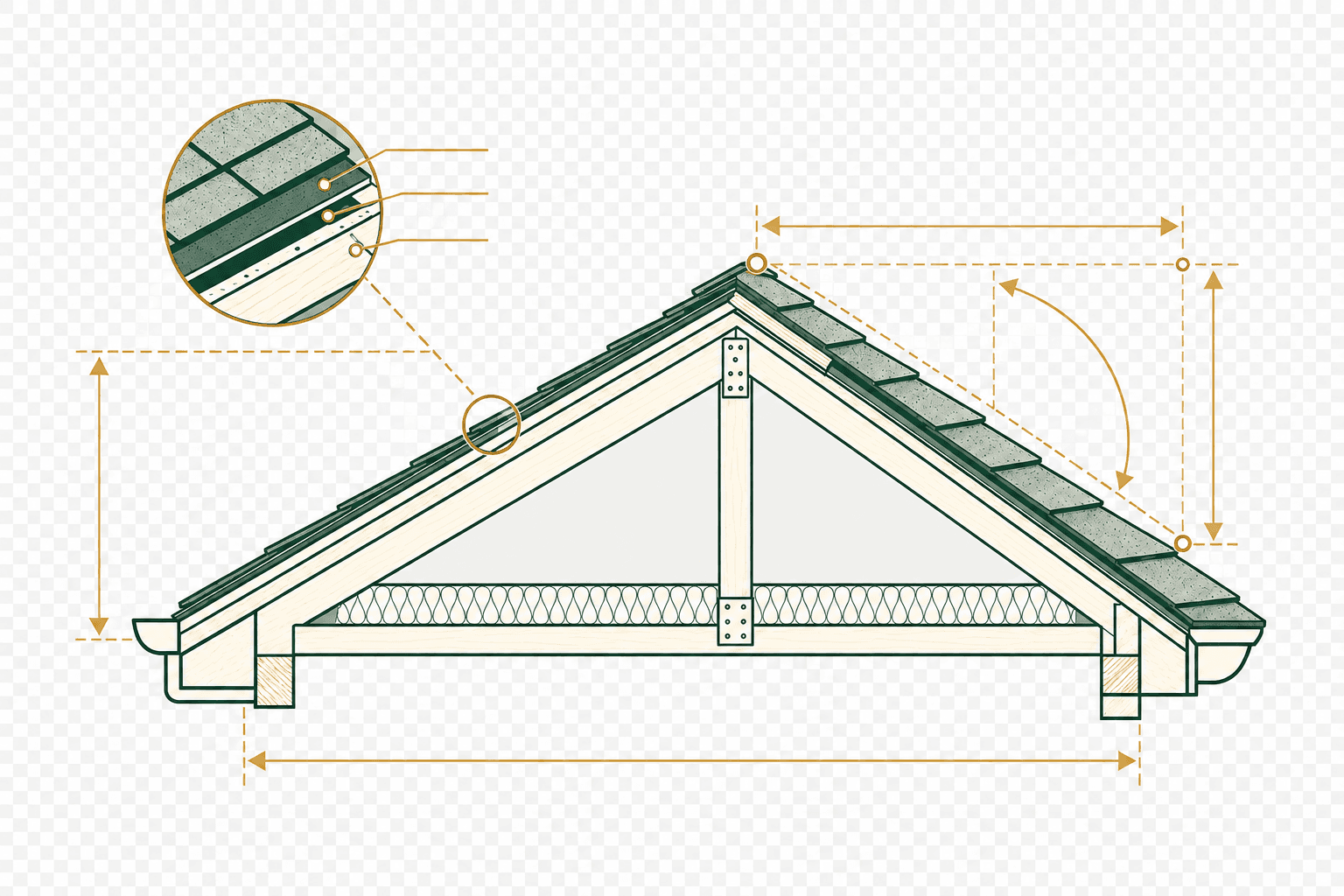
Plan your roofing project
Roofing quantities depend on the roof area you know and the parts of the roof that are still assumptions. If you have a measured surface area, use it directly. If you only have a footprint and one uniform pitch, the shingle tool can provide an early shortcut and show the slope factor used. The pitch tool can check rise and run before you use that value elsewhere.
Use the bundle tool when the roof area or roofing-square count is already known. Use the underlayment tool for roll coverage and overlap. These tools help organize a material conversation with a supplier; they do not replace a roof plan or safe inspection. Dormers, valleys, hips, multiple pitches, flashing, starter materials, local requirements, weather, and safe access can change the final order and the work method.
Before entering a footprint, decide whether you are describing the roof surface or only the building projection. List the roof planes and note dormers, valleys, hips, overhangs, and different pitches. If a roof plan or measured surface area is available, use that information. It reduces the number of assumptions carried into the buying estimate.
Use product information for every package conversion. Bundles per square and roll coverage belong to the exact product, while overlap and waste depend on the roof and instructions. Keep accessories such as starter strips, ridge caps, valleys, flashing, and disposal in the same buying checklist. Do not use the site as a substitute for safe roof access or professional inspection.
If the roof has more than one plane or pitch, keep the measurements grouped instead of forcing them into one footprint. A supplier or qualified professional can then see which parts are known and which parts still need a site check. The goal of an early estimate is to make the next question clear, not to hide uncertainty behind a precise-looking bundle count.
Choose the right calculator
Start with the roof measurement or material quantity you already have.
- Roofing Shingle CalculatorEstimate roof surface area, roofing squares, and shingle bundles from area or pitch.
- Shingle Bundle CalculatorConvert roofing area or squares into whole shingle bundles.
- Roofing Underlayment CalculatorEstimate underlayment rolls, required coverage, package overage, and cost.
- Roof Pitch CalculatorConvert rise and run into pitch, angle, and slope factor.
Planning considerations
- Use surface area when it is known, and keep footprint shortcuts limited to the assumptions they show.
- Check pitch, roof planes, valleys, hips, dormers, overhangs, and waste before a final order.
- Use product coverage for bundles and rolls, and follow manufacturer and local requirements.
Before you buy
- Confirm bundles per square, roll coverage, overlap, starter strips, ridge caps, valleys, and flashing.
- Ask how the supplier defines delivered coverage and what accessories are sold separately.
- Do not use a calculator as roof-access or installation instructions. Use a qualified professional when access or geometry is uncertain.